
Introduction to Battery Monitoring Systems
Battery type: For Lead acid and Nickel Cadmium Batteries
Advanced battery monitoring for greater reliability in critical power systems
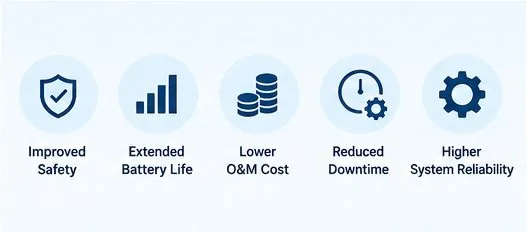
Keep critical battery systems dependable, reduce the risk of unexpected interruptions and support longer service life. Battery monitoring helps operators understand battery condition, spot developing issues early and make informed maintenance decisions before performance is affected.
What is a Battery Monitoring System?
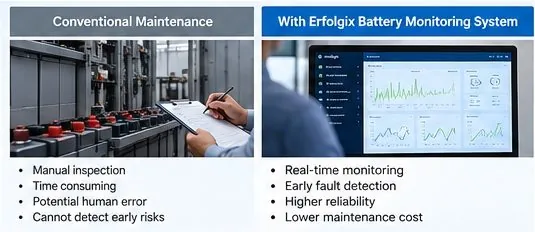
A battery monitoring system (BMS) is one of the core battery monitoring solutions and products for critical power: a platform that measures battery condition at string and cell level, shows it in one place, and alerts you when limits are crossed. It replaces occasional manual readings with continuous data for UPS, telecom, utility and data-centre backup power.
Measure
Voltage, temperature, resistance and more
View
One dashboard, across sites where supported
Alert & review
Email, SMS or app alerts, plus history and trends
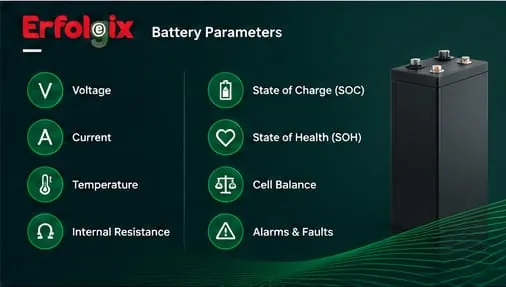
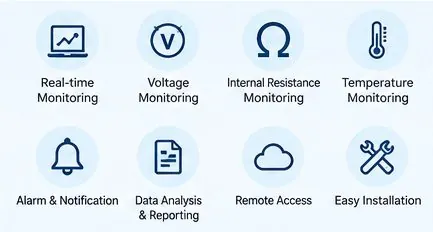
What it can monitor (depending on configuration)
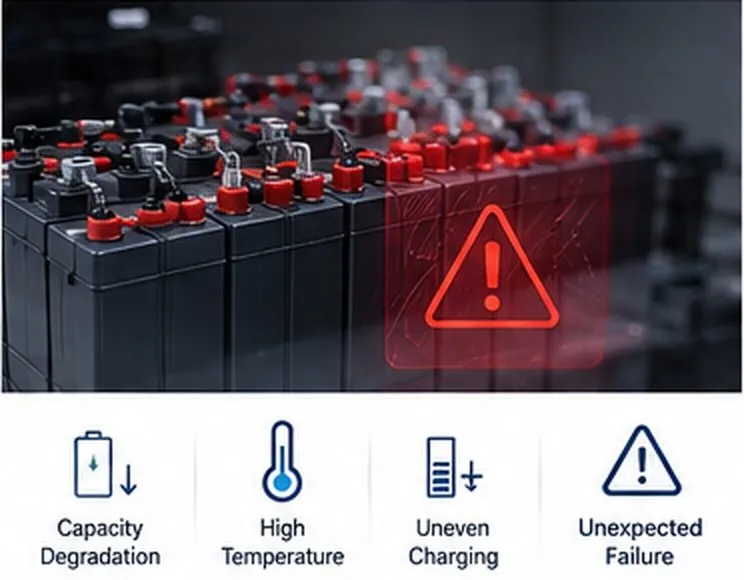
Common battery problems that hide in plain sight
Batteries age gradually, and visual checks miss the early signs.
Performance changesCapacity fade, rising internal resistance
Connection concernsLoose or corroded terminals, unnoticed faults
Environment and safetyHeat, ventilation, leakage risks
Visibility gapsManual readings, little history, hard to trace
The weakest-battery effect: one weak battery limits the whole string
In series strings, the weakest unit sets the limit, even when the rest look healthy.
Why batteries differ
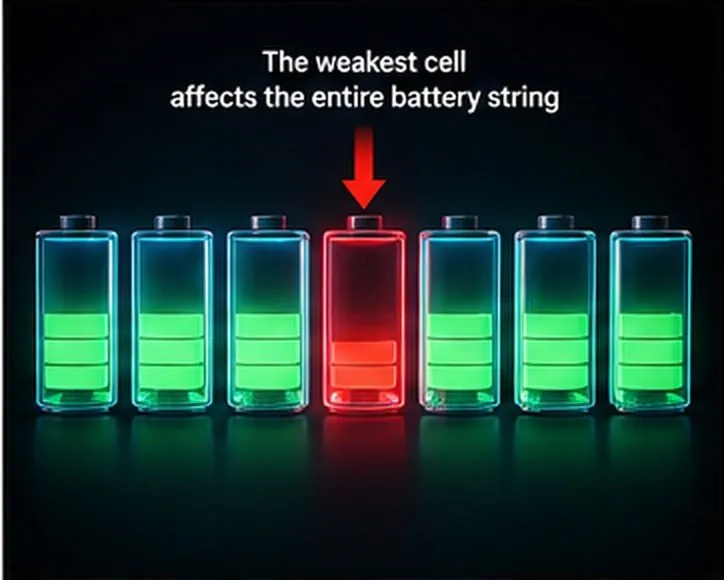
If a weak unit is missed
Shorter backupLess runtime than expected
Urgent fault-findingInvestigation under time pressure
Early or late replacementHigher lifecycle cost or risk
Safety concernsUnaddressed abnormal conditions
Why choose Erfolgix for battery monitoring
Application-focused
Shaped around site needs and criticality
Lifecycle support
Planning to troubleshooting, per agreed scope
Knowledge sharing
Guidance to turn battery data into action
Key features of a battery monitoring system
Battery-level monitoringCompare batteries within a string
String and system monitoringOverall voltage and current
Alarm managementAlerts when values leave set limits
Historical data and trendsSpot change over time
Centralised viewingLocal or remote, with user permissions
Features depend on the controller, sensors and software supplied.
Battery monitoring applications across critical industries

Monitoring levels
String-level vs cell-level battery monitoring
Both levels matter. String data tells you what the bank is doing; cell data tells you which battery is causing it.
| Level | What is measured | What it tells you |
|---|---|---|
| String level | String voltage, charge and discharge current, SOC, SOH | Whether the bank is on float, charging or discharging, and its overall health |
| Cell / block level | Cell voltage, temperature, internal resistance (ohmic value) | Which individual battery is weak, hot or ageing faster than the rest |
| System level | Ripple voltage, discharge graphs, alarm history | Charger and UPS behaviour, and how every block performed during an outage |
Battery chemistries
Monitoring lead acid, VRLA and Ni-Cd batteries
Lead acid (flooded)
2 V cells common in utilities and large industrial DC systems.
Read the guide →VRLA (AGM / gel)
Sealed 2 V cells and 12 V monoblocs used in UPS and telecom. Cannot be inspected internally, so electrical monitoring is key.
Read the guide →Nickel cadmium (Ni-Cd)
Robust cells for substations, oil and gas, power plants and railways.
Read the guide →Regional focus
Battery monitoring in the UAE, GCC, India and worldwide
High ambient temperatures, rapid growth of data centres and utilities, and many remote or unmanned sites make continuous battery monitoring especially valuable in Dubai, Abu Dhabi, Riyadh, Doha, Muscat, Kuwait City, Manama and across India, and the same benefits apply to critical sites all over the world. Temperature is a major factor in battery life, and remote alarms let a central team supervise many sites.
Erfolgix is based in Dubai Silicon Oasis and supports projects across the region and globally. Use our project checklist for the UAE, GCC, India and worldwide to prepare a specification, or see battery monitoring in the UAE and Dubai.
From theory to practice
How Erfolgix battery monitoring solutions and products put this into practice
The Erfolgix 7000S battery monitoring system is a gateway BMS for lead acid 12V batteries, 2 V cells and Ni-Cd banks. It combines one-to-one cell sensors (including the cell sensor for 12 volt battery BS-12V), the String Current Detect Module – AM with Hall sensor, the String Voltage Detect Module – UM, a 10 inch touch panel HMI configured with BMS-Gate, and the BMS-Gate gateway with a built-in web server. It measures cell voltage, temperature and internal impedance, calculates SOC and SOH, raises alarms by voice, SMS, e-mail and sound-light, and logs 12 months of data for export as JPG, PDF or XLS.
FAQ
Battery monitoring FAQ
What is a battery monitoring system (BMS)?
A battery monitoring system is a platform that measures the condition of a battery bank, at string level and at individual cell or block level, shows the results in one place, and raises alerts when values cross set limits. It turns manual, periodic readings into continuous data.
Why is battery monitoring important for backup power?
In a series string, the weakest battery limits the whole string. A single weak cell can shorten backup time even when the other cells look healthy. Continuous monitoring finds weak or deteriorating units early, before the backup is needed.
What is the difference between string monitoring and cell-level monitoring?
String monitoring measures overall string voltage and current. Cell-level monitoring measures each cell or block individually (voltage, temperature and internal resistance), so a single failing unit can be identified and replaced instead of guessing or replacing the whole string.
Why measure internal resistance?
Internal resistance (ohmic value) tends to rise as a battery ages or develops a fault. Tracking it over time for every cell helps reveal deterioration that voltage alone may not show while the battery is on float charge.
Does battery monitoring replace capacity testing and maintenance?
No. Battery monitoring complements manufacturer instructions, periodic capacity testing and site safety procedures. It gives your team better information to decide when and where maintenance is needed.
Where are battery monitoring systems used?
Typical applications include UPS systems in data centres, telecom sites, power generation and utilities (including substations), railways, oil and gas and industrial facilities. See our guides on UPS battery monitoring and telecom and substation batteries.
More answers in our FAQ.
Knowledge centre
Further reading on battery monitoring
Practical guides for facility engineers, consultants and maintenance teams in the UAE, GCC, India and worldwide.
UPS Battery Monitoring for Data Centres
Why data centres in the UAE, GCC, India and worldwide monitor every UPS battery, what to measure and how alarms protect runtime.
Read the guide →Lead Acid & VRLA Battery Monitoring Guide
Parameters, alarm limits and maintenance practice for flooded and VRLA lead acid battery banks.
Read the guide →Ni-Cd Battery Monitoring for Industry & Utilities
How nickel cadmium battery monitoring supports substations, oil and gas and power plants.
Read the guide →Battery Monitoring for Telecom Sites & Substations
Remote monitoring of DC backup batteries at unmanned telecom shelters, substations and railway sites.
Read the guide →Battery Monitoring Project Checklist: UAE, GCC, India & Worldwide
Heat, site access and integration: what to plan for a battery monitoring project in the region or anywhere in the world.
Read the guide →Wireless Vibration Monitoring for Pumps, Motors & Fans
Wired vs wireless condition monitoring, sensor placement and how to plan gateways and coverage.
Read the guide →Have a battery monitoring project in mind?
Contact Erfolgix to discuss your requirements.